
Dual-probe field testing with automated Flownamics Seg-Flow® switching and high-flow ceramic membranes
Automated metabolic monitoring can help reduce risk and support predictable outcomes during extended-duration or high-density cell culture processes. Maintaining consistent sample flow through a single sampling membrane can become increasingly challenging as culture duration and cell density increase.
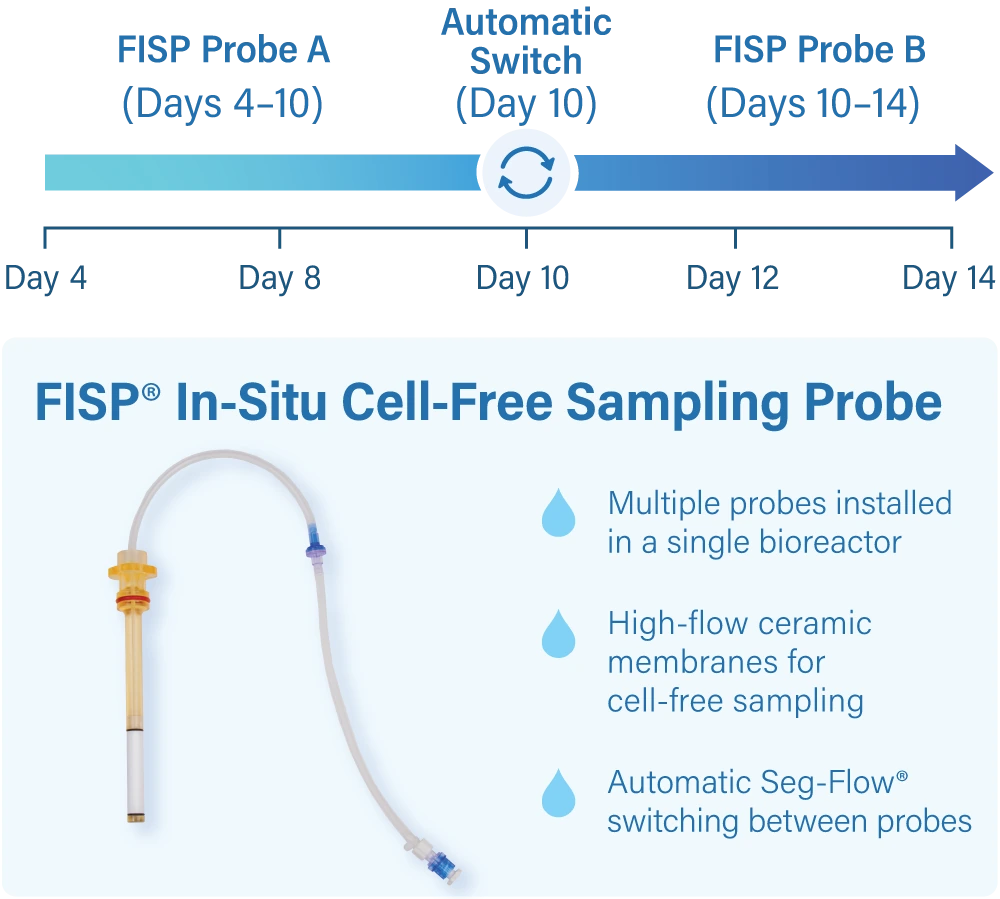
Using a Dual FISP® Sampling approach, Flownamics field testing demonstrated sustained cell-free sampling during an extended, high-density culture run. Two FISP® In-Situ Cell-Free Sampling Probes, each equipped with Flownamics’ new high-flow ceramic membrane, were installed in the same bioreactor and connected to a single Seg-Flow® automated sampling system. During the field test, sampling began through the first probe, and the Seg-Flow automatically switched to the second probe at Day 10. This transition provided a fresh membrane for the later stages of the culture, allowing sampling to continue without manual reconnection of the sampling source.
Two Probes. One Continuous Automated Sampling Strategy.
Rather than relying on a single membrane throughout an extended, high-density cell culture run, the Seg-Flow automatically transitions sampling between two FISP probes:
- FISP Probe A: Automated cell-free sampling from the beginning of the run through Day 10.
- FISP Probe B: During the field test, the Seg-Flow automatically switched to the second probe at Day 10. Figure 1 shows analytical results through Day 14; sampling continued through Day 15.
During the field test, the Seg-Flow automatically switched to the second probe at Day 10. Figure 1 shows analytical results through Day 14; sampling continued through Day 15.
Strong Agreement Between Automated and Manual Sample Results
Figure 1 presents titer results from a Flownamics Seg-Flow connected to two Flownamics FISP In-Situ Cell-Free Sampling Probes, identified in the graph as FISP Probe A and FISP Probe B. The Seg-Flow automatically switched between the two FISP probes during the culture run and delivered the cell-free samples for on-line HPLC analysis. The graph compares the automated FISP results with Roche Cedex BioHT and off-line HPLC measurements. Two samples were taken each day.
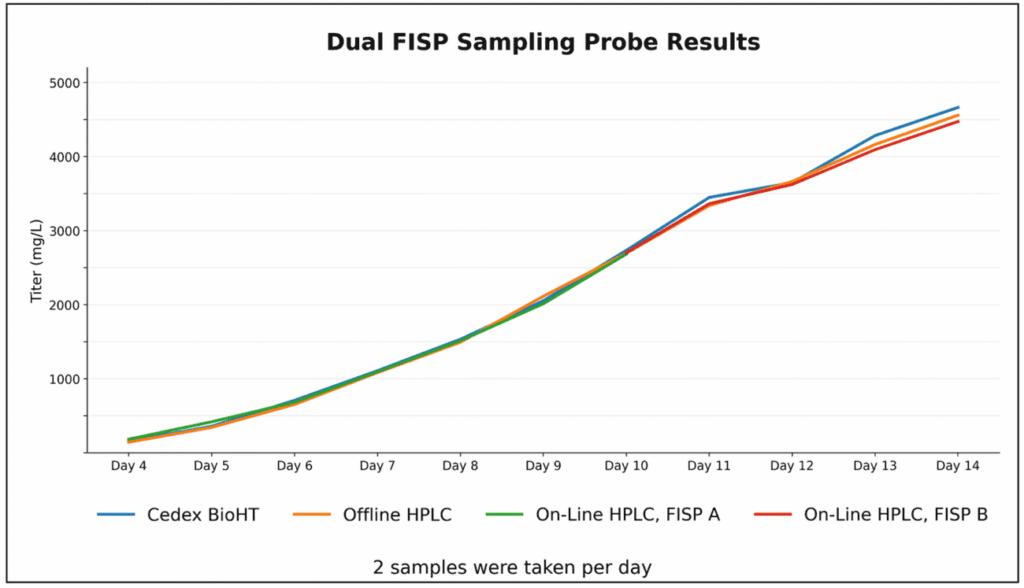
Figure 1. Titer results with Flownamics Seg-Flow automated sampling system connected to two Flownamics FISP In-Situ Cell-Free Sampling Probes (FISP Probe A and FISP Probe B). Note: The graph shows the analytical comparison through Day 14. Field testing continued through Day 15 with adequate cell-free sample volumes obtained to meet analytical requirements.
What the Data Show
- Figure 1 shows titer results from automated samples collected by a Flownamics Seg-Flow connected to FISP Probe A and FISP Probe B.
- The Seg-Flow automatically switched to Probe B at Day 10, allowing the automated sampling sequence to continue with a fresh second membrane.
- Automated FISP sample results closely tracked the titer trends measured by off-line HPLC and Cedex BioHT.
- FISP Probe A sampled during the earlier portion of the run. FISP Probe B sampled during the later, higher-cell-density portion.
- After the transition, Probe B results remained closely aligned with the off-line HPLC results, with no apparent break in the titer trend.
- At the highest titers shown, automated and reference measurements remained closely grouped, supporting the representativeness of the automated samples.
Representative Cell-Free Sampling During an Extended, High-Density Run
Field testing demonstrated continued collection of cell-free samples at volumes sufficient to meet analytical requirements through Day 15. The analytical comparison shown in Figure 1 supports the representativeness of the automated samples through Day 14.
The automated samples collected by the Seg-Flow through the FISP probes also demonstrated strong agreement with manually collected samples, providing additional confidence that the Dual FISP Sampling approach was delivering representative process samples.
Extending Automated Sampling for Long Cell Culture Runs
Combining two FISP probes, the new Flownamics high-flow ceramic membrane and automated Seg-Flow probe switching helps maintain reliable, automated cell-free sampling during extended, high-cell-density culture runs.
This configuration divides the sampling workload between two probes. During this field test, the Seg-Flow automatically switched to the second probe at Day 10, providing a fresh membrane for the later portion of the culture to maintain reliable sample availability through the critical final days of the run.
Key Benefits
- Automated cell-free sampling during extended, high-density culture runs
- Close agreement between automated FISP sample results and manual analytical results
- Representative titer results throughout the culture run
- Consistent availability of sample volume required for analysis
- Fresh membrane for the later, higher-cell-density portion of the run
- Automatic Seg-Flow switching between FISP Probe A and FISP Probe B
- Continuous automated sample collection without manual reconnection of the sampling source
- Reduced dependence on manual sample collection during extended cell culture runs
- Automated sampling without interrupting the bioprocess
Maintain Automated Cell-Free Sampling Through the Final Day
For extended, high-density cell culture processes, a Dual FISP Sampling approach with automated Seg-Flow switching provides an effective strategy for maintaining reliable automated cell-free sampling when it matters most — through the end of the run.
